About Moving Lines
Moving Lines is a visual narrative of the journeys taken by people who left their hometowns in search of a better life.
M., M., M., B., S., O., I., A., R., F., M., M. and R. are asylum seekers who arrived from various parts of the world. They have crossed countries and borders, travelling along the Mediterranean or Balkan routes to reach Italy and Europe.
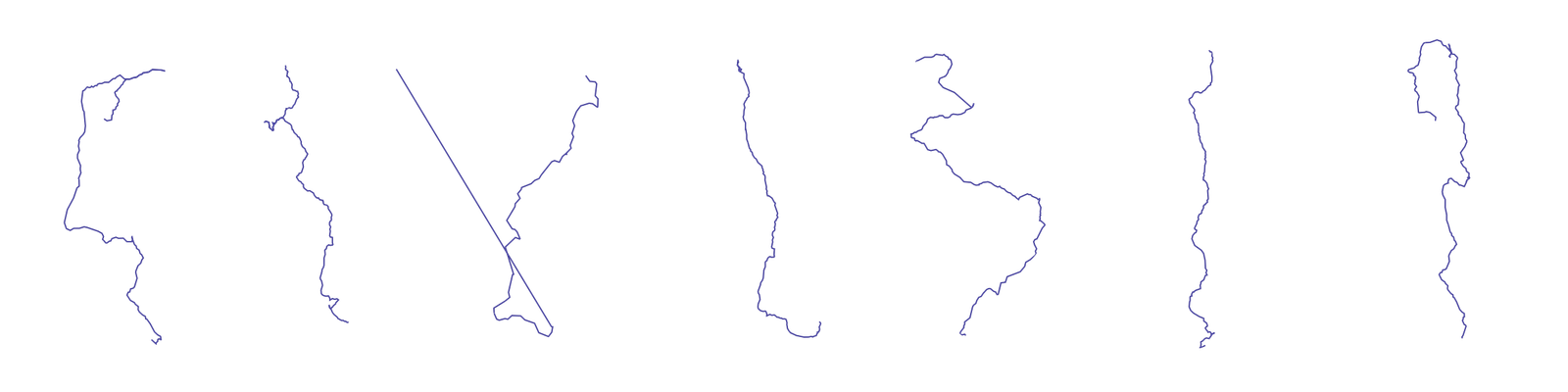
Moving Lines are stories in movement, like the journey each person has taken, with a common starting point: the search for a (new) opportunity.
The project aims to give shape to these stories and these journeys, walking step by step alongside those who have travelled them, tracing their path into a line. For each narrator, a unique and personal line was drawn, shaped by their experiences. For every step of the journey, information was collected about the means of transport and the number of days spent travelling.
The interviews were designed to encourage self-narration.
For this reason, in some parts of the lines there are quotes or notes: these mark the moments in which people shared a more detailed fragment of their story. Some data are missing: in some cases the information could not be recalled. Imperfections and missing data were never considered a problem.
The narrators were interviewed by Silvia Costantini from May 2021 onwards: in Trieste, with the support of ICS (Italian Consortium of Solidarity); in Rome, with the support and hospitality of Liberi Nantes; and on the Italian-French border. Complete anonymity was guaranteed to each participant.
A special thanks for their trust in the project, their support and their warm welcome to:
- ICS, thanks to Gianfranco Schiavone and Matej Iscra;
- Liberi Nantes, thanks to Alberto Urbinati, coaches Jean (Honba Jean Bosco) and Rino (Salvatore Di Costanzo), the entire football team, and all the association’s staff and volunteers.
The interviews are ongoing, in line with the project’s objectives.
Moving Lines is not a finished project – quite the opposite! Its launch marks just the beginning, because the ultimate aim is to hand it back to people on the move who want to share their stories and leave a record of their lives, until one day every journey is equally possible, with the same rights and the same natural freedom for everyone to seek a better life.
Moving Lines was developed as a continuation of «The Stories Behind a Line», a visual narrative of six asylum seekers who arrived in Italy in 2016, created by Federica Fragapane in collaboration with Alex Piacentini.
Now the journey of «Moving Lines» begins.
We would love to share it within social and academic communities and beyond, bring it into schools, spark discussions, encourage and listen to questions, and enrich it together — but also to refocus attention and care on storytelling and journalism that puts stories and those who tell them at the center.
AUTHORS
Silvia Costantini, freelance journalist. Her daily challenge is to apply data analysis and a scientific approach to social and investigative journalism, producing articles and reports based on data and generative storytelling that give voice to the truth of the story. Over the years, she worked as a press officer, journalist, editor and author in the non-profit sector, on social journalism projects in schools, and as a speaker and moderator at conferences on the topic of migrants. Recently, she’s been moving between Rome and the borders.
Federica Fragapane, independent information designer. Over the years, she has created data visualization projects for the United Nations, the World Health Organization, the Publications Office of the European Union, the BBC, Scientific American, Google, Triennale Milano.
In 2023, three of her data visualizations became part of the permanent collection of the Museum of Modern Art in New York.
Across many of her projects, she adopts an experimental approach, carefully selecting visual languages to invite readers to explore the stories told by the data.
Alex Piacentini, designer & creative developer based in Milan. In his work he uses the web and other digital media as multidimensional materials to build projects where code, data and interactivity merge at the intersection of generative design, dataviz, visual art and sound synthesis. Collaborations include institutions like UNFCCC and Columbia University, art galleries like IMPAKT and Futures Photography, music and art festivals (AND in Liverpool, Transart in Bolzano, Transmedia Research in Fano), artists like Zach Blas and Alessandro Zannier for the Venice Biennale.